
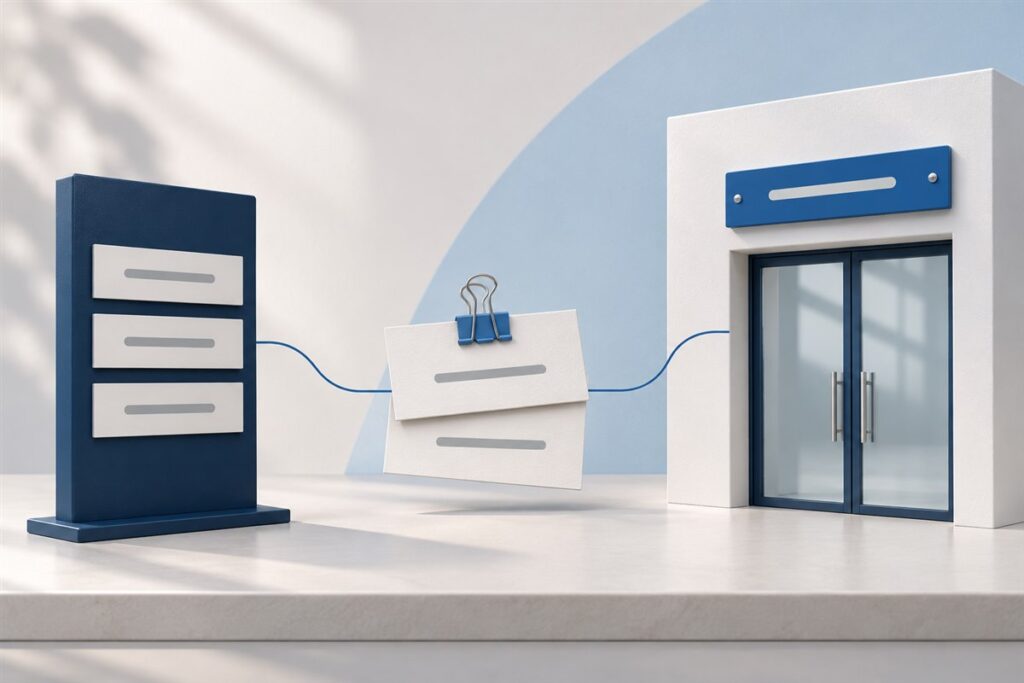
A directory may list “Cedar Suite,” an event page may advertise “Cedar Meeting Room,” and the label beside a door may say “Cedar Room.” Before copying any of those names onto a new sign, establish whether they describe the same destination. Similar wording is not enough to make that decision, and a familiar marketing name may refer to a larger area rather than one room.
A destination naming crosswalk records those relationships before the wording enters the sign artwork. For a package of pylon and directional signs, it helps the buyer distinguish a name that has been approved from one that is merely circulating in project material. It is a proposed content-review method, not a claim that naming or site-verification services are included in the order.
Collect the names against a place, not against a sign
Start with a location reference the responsible site team can identify, such as a room reference on the current plan. Then list the names encountered in the directory, website, booking material and label at that location. Note where each wording came from. Do not silently replace one spelling with another while collecting the information.
Include the current arrival label even if it is expected to change. That label is part of the naming question: will the new directional wording lead to a place carrying that name, or is an update still undecided? An old label should not automatically control the new wording, but neither should it disappear from the discussion.
Resolve identity before choosing the preferred name
Ask the site content owner whether the different references identify one destination, separate destinations or different levels of the same facility. A promotional name for an event space might include several rooms; a directory entry might identify only one of them. Those are not necessarily interchangeable labels.
Record the answer against the location reference. Where identity is uncertain, keep the entries separate and mark the relationship pending. Ask who can resolve it and what location information they need. The manufacturer should not have to infer the property’s naming policy from a collection of similar names.
Our wayfinding design guide already explains the importance of consistent destination names. This crosswalk handles the narrower question that comes before consistency: which names actually refer to the same place, and which wording has the owner accepted?
Choose the public name and any short form explicitly
Once the destination is identified, ask the authorized content owner to select the wording intended for visitors. Record the full display name and any permitted short form as separate decisions. A marketing title, internal department code and door label need not all have the same length, but their relationship should be deliberate rather than assumed.
Do not create an abbreviation simply because a line looks crowded. Ask whether the shortened wording remains identifiable at this property and whether it could be confused with another destination. If the owner has not accepted a short form, leave it pending and return the wording-and-layout question for review.
Also record what is expected to appear at arrival. If the proposed display name differs from the existing arrival label, the owner needs to decide whether the difference is acceptable, whether wording should change or whether another reference needs updating. This is a content decision; the crosswalk does not authorize changes to the building’s labels.
Use a destination naming crosswalk
The following examples are fictional and illustrate different decision states, not completed customer projects. Replace them with actual location references and owner decisions. On a phone, swipe the table horizontally to see all four columns.
| Identified location | Names encountered and source | Identity or alias decision | Approved wording and responsible owner |
|---|---|---|---|
| D14 on the property’s current plan | Directory: Cedar Suite; event page: Cedar Meeting Room; arrival label: Cedar Room | In this fictional example, the site owner confirms all three refer to D14 | Full display name: Cedar Room. Short form: pending. Record the content owner’s approval and intended arrival wording. |
| D21 reference awaiting confirmation | Directory: Studio; booking material: Studio 2 | Unknown whether these identify one room or two; do not merge | Copy pending. Ask the site content owner to confirm the location relationship. |
| D40 and D41 are separate locations | One source calls D40 Garden; another calls D41 Garden Cafe | Do not treat the shared word as evidence of one destination | Retain separate entries. Obtain the accepted public name and any short form for each. |
| Enter the actual location reference | Enter each wording with its source, including the arrival label | Record confirmed same place, distinct place or pending | Enter the full name, permitted short form, arrival relationship and named approver |
Carry the decision into the proposed sign copy
When reviewing the artwork, compare the destination wording with the accepted crosswalk entry. If an unexpected abbreviation appears, ask whether it is an approved short form or a new proposal. Keep that distinction visible instead of allowing a layout adjustment to become a naming decision without review.
A crosswalk supplements the wider sign schedule; it does not specify routes, arrows, sign quantities or construction. Its job is to give the project team an explicit answer about names for an identified destination. Keep unresolved identity conflicts with the owner rather than presenting them to the fabricator as settled copy.
Send HLW SIGN your destination references, approved names and remaining naming questions when discussing a directional sign package. Include the proposed sign information separately so the team can distinguish accepted wording from open decisions. Browse the buyer resources for other design and order questions.