
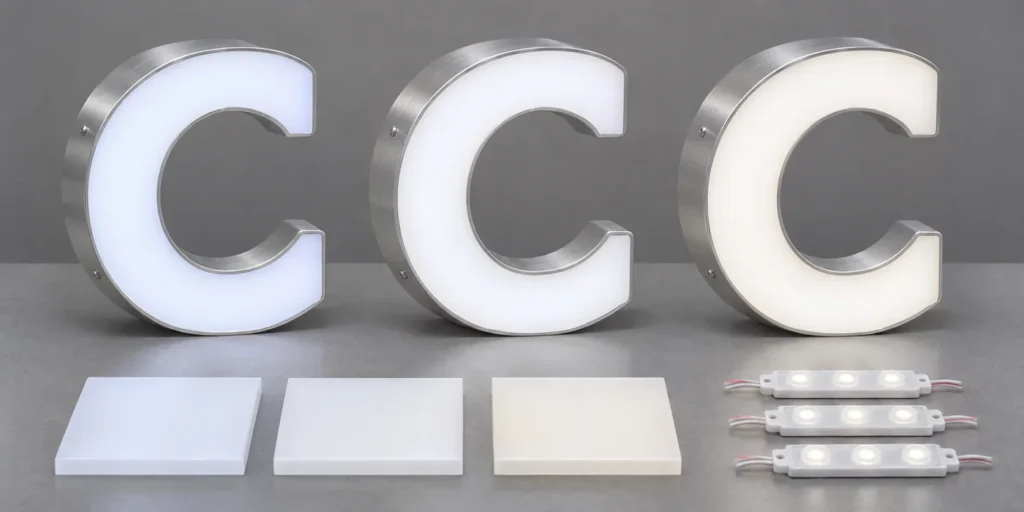
Two sets of white LED letters can carry the same nominal color-temperature description and still look different when illuminated together. The reason may involve the light sources, their grouping, the diffuser, the sign construction or the viewing conditions. For a new order or a repeat batch, define a complete sample-approval process instead of relying on a kelvin label alone. The aim is a clear reference that the buyer and manufacturer can review consistently.
Treat the finished letter as the sample
LED data describes a component, while the visitor sees the complete letter. Face material, diffusion, letter depth and the arrangement of the light source affect the visible result. For LED channel letters, compare the proposed construction rather than a bare strip held behind an unrelated piece of acrylic. Identify which materials and components were used in the approved sample so the review can be connected to production.
Understand what a nominal CCT leaves open
A correlated color temperature describes the apparent white-light direction, but it does not fully describe spectral behavior or every visible difference. DOE’s discussion of color-tunable LED products explains why different light-source combinations can reach the same nominal CCT. This does not mean specifications are unhelpful; it means the written specification and the finished sample should work together rather than treating one number as the entire approval.
Ask how component consistency is managed
Binning groups LEDs by output characteristics and is used in lighting manufacturing to support consistency. Signify’s color-science material provides context for that process. Ask which characteristics are controlled in the proposed components and how substitutions will be handled. Do not turn a generic discussion of binning into an unsupported promise about a particular tolerance, a number of MacAdam steps or perfect uniformity across every sign produced.
| Possible difference | Useful review | Record to retain |
|---|---|---|
| White-light appearance | Matched finished samples under the same conditions | Sample and component references |
| Face diffusion | Illuminated face, not just bare LEDs | Face material and construction |
| Letter-to-letter variation | Whole word or representative group | Agreed viewing conditions |
| Repeat batch | New sample beside the retained reference | Drawing and component revisions |
| Existing installation | Condition and age of the installed sign | Site photographs and specification history |
Use consistent viewing conditions
Compare samples side by side with the same power and control conditions, background and ambient light represented. Review them at useful distances, not only from a few centimeters away. Avoid using photographs from different cameras as the sole color comparison. For illuminated mini acrylic letters, small details and face construction can be especially important to the appearance, so review an example representative of the final lettering rather than a larger, simpler test shape.
Keep halo effects separate from face-lighting checks
In a halo-lit sign, the wall becomes part of the visible light effect. An accepted LED component does not make two different mounting surfaces look identical. backlit LED letters therefore need a review that includes the wall finish and standoff arrangement. Define whether you are approving the face, the halo or both. Keeping those questions separate makes it easier to identify the reason for a difference and agree what needs to be adjusted.
Retain a reference for reorders and maintenance
Store the approved sample reference, drawing revision, component specification and review conditions together. If a future order changes a material or component, ask how the resulting sample will be checked. A new replacement beside an older sign may also reveal differences caused by service conditions and aging. Provide the installation history rather than asking for an exact match from a single photograph. A written comparison procedure makes the discussion more useful than an undefined request for “the same white.”
Frequently asked questions
Does matching the kelvin value guarantee the same appearance?
No. It is a useful specification, but it is incomplete on its own. Review the finished construction and the agreed component characteristics under comparable conditions.
Can a photograph be used as a production color standard?
Use it for communication, but remember that exposure, white balance and screens affect the result. Retain an identified physical reference when appearance matching is important.
Should a replacement be compared with the original specification?
Yes. Also provide the installed sign’s age and conditions. A new sample and an existing sign may differ for reasons that cannot be established from the product name alone.
Plan your sign with HLW Sign
Send your white-light preference, letter design and any existing sample or installation reference. We can discuss an appropriate finished-sample review for a new order or repeat batch. Send your project details to discuss a suitable construction and quotation.