
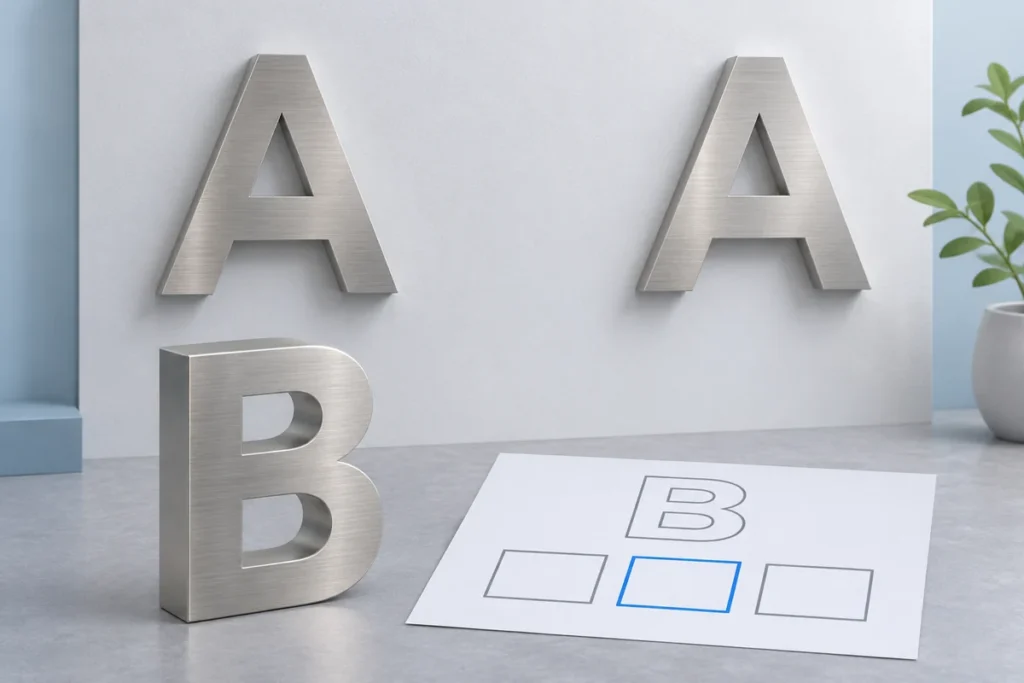
Replacing one missing letter is a different brief from ordering a new wordmark. The replacement must be considered beside the pieces that remain, in a particular position on a particular wall. A letter that looks similar on a supplier’s product page does not establish that its outline, depth or appearance will match that existing sign.
This guide concerns non-illuminated metal letters, whose effect comes from material, finish and shadow rather than internal LEDs. Start by asking whether HLW SIGN can assess the proposed single-letter replacement. The published custom-letter range does not establish acceptance of a one-letter order or guarantee a match to another maker’s work. The brief below helps the team evaluate the request before discussing a quotation.
Give the replacement a position, not only a letter name
Identify the complete wording and mark the exact character being discussed. If the same letter appears twice, “replace the L” is ambiguous. In an illustrative WALL wordmark, “character 4, the final L” identifies a different position from character 3. Label the same position on the overall photograph, artwork and any detail reference.
Show the complete installed arrangement, the gap or affected character, and the neighboring letters. Explain which side is the front and how the character is oriented when viewed in its intended reading position. Keep the surrounding pieces in the reference: they show the alignment and spacing the replacement is expected to join. A close-up of an isolated letter loses that relationship.
Separate original evidence from a new interpretation
Look for the original production artwork, approved drawing, order reference or installation layout. Identify the revision and explain which files are known to describe the installed sign. An early logo proposal may differ from what was eventually made. If only a photograph or an approximate font identification is available, state that limitation rather than presenting it as confirmed geometry.
The vector artwork preparation guide explains the separate issue of editable outlines. For this replacement request, the question is whether the available outline actually belongs to the existing character. Ask what additional reference would be needed to evaluate it.
Use a match record with three different evidence levels
Fill this record with information that can be obtained from existing documents or safely available observations. Label the source of every confirmed measurement. A dimension estimated from a photograph should remain unconfirmed until the responsible local representative checks it.
| Verified existing detail | Still to confirm | Requested result |
|---|---|---|
| Position: complete wording, marked character number and neighboring pieces. | Whether every reference shows that same installed position. | The replacement joins the identified gap in the existing arrangement. |
| Outline: identified original file, drawing or clearly described reference. | Whether it represents the final installed geometry; any missing details. | The proposed outline is reviewed against the retained lettering. |
| Orientation: front view and intended reading direction, with references labelled. | Any uncertainty about front/rear views or a reversed image. | The proposal shows the character in the required orientation. |
| Dimensions: confirmed height, width, depth or layout data, with their sources. | Values that are estimated, absent or awaiting a local check. | A drawing identifies the proposed dimensions before approval. |
| Interface: available installation drawing or information supplied by the local installer. | Which existing installation details the manufacturer can evaluate. | The relevant parties confirm the proposed interface separately. |
| Surface reference: available original finish reference and current photographs. | How the existing appearance should be compared with a new proposal. | The buyer understands the proposed visual match and any limitations. |
This is a suggested information record, not confirmation that a replacement is feasible or that a particular fixing arrangement is supplied. Missing fields help identify the next question; they should not be filled with assumptions to make the record appear complete.
State which existing appearance the new letter should approach
Explain whether the requested reference is the original approved appearance or the current appearance of the retained letters. If those are different, identify which one matters for the proposal. Ask how the team would review the relevant surface reference and what uncertainty remains. Do not treat a named metal or a screen color as a promise that a new piece will be indistinguishable from an existing one.
Keep finish as one part of the match brief. Our sign finish specification guide covers the broader sample discussion; repeating that process does not resolve an unknown character outline or installation position.
Decide what to do when a reference is missing
Ask the manufacturer to separate the information needed to evaluate the request from the information needed before any production approval. This avoids confusing an initial feasibility discussion with an accepted manufacturing instruction.
- Original references available: identify the installed version and ask which details still need checking.
- Some references missing: describe the gaps and ask what additional local information would make an assessment possible.
- A match cannot be confirmed: request an explanation of the limitation before deciding whether a different scope is worth reviewing.
Do not interpret silence about an unknown field as acceptance. Keep the proposed scope separate from the desired outcome until both parties have identified what can actually be assessed.
Send one concise replacement request
Adapt this wording: “Please assess whether you can consider a single non-illuminated metal-letter replacement for character [position] in [complete wording]. Attached are the overall installation view, marked position, available original files and the match record. Please identify missing information, any limits on matching the retained letters, and whether this request can be accepted before preparing a quotation.”
Send HLW SIGN the existing-sign references for review, together with the delivery country and the contact responsible for local confirmation. Ask the team to confirm feasibility, order scope and the next approval material. A useful first decision is whether enough reliable information exists to proceed.