
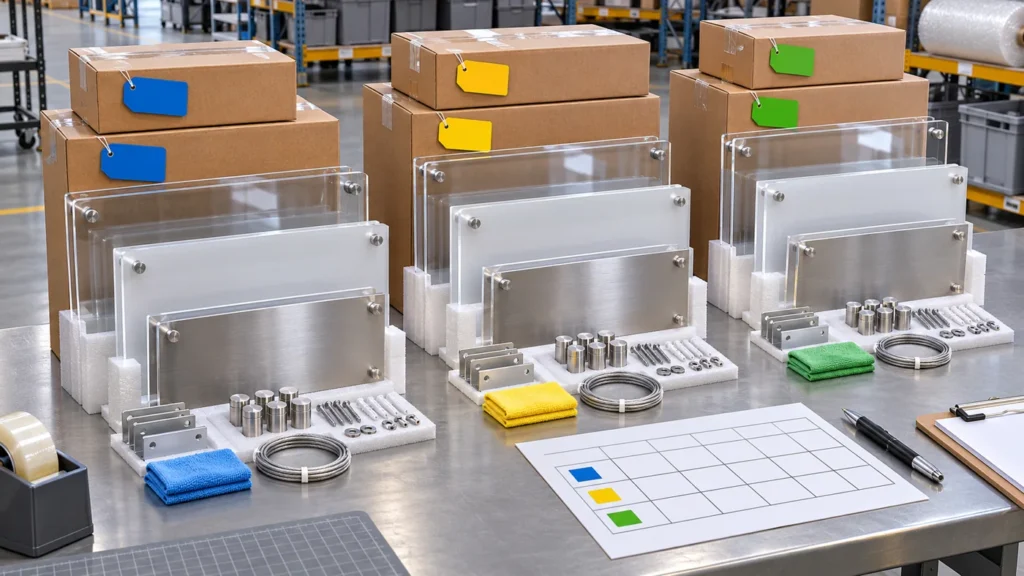
A multi-store sign order can contain one brand identity and many different physical requirements. A storefront may need a different width from another branch, and a reception logo may use different fixings or power arrangements. An allocation sheet connects those variations to the correct destination. Its purpose is practical: the factory, packer, carrier and receiving team should be able to identify which approved sign and accessory set belongs to each location.
Give every location a stable reference
Start with a store or site code that will not change when a delivery contact is updated. Add the destination address, receiving contact and the person responsible for approval. Use the same code on the drawing record and packing list. A descriptive store nickname can help, but it should not be the only identifier when two branches have similar names or when a project includes temporary delivery addresses.
Map the drawing revision to the destination
Record the approved drawing number and revision for each site. If a branch needs a revised size, update its record rather than changing an unlabeled file in a shared folder. For custom LED channel letters, letter dimensions, mounting arrangement and cable positions can vary between locations even when the logo is unchanged. The allocation sheet should point to the approval record; it should not replace the dimensioned drawing.
Track accessories as part of the sign
A package can contain the right logo and still be incomplete for the intended site. Include the specified power supply, controller where applicable, mounting parts and installation references in each location’s allocation. A rollout containing custom neon light signs and LED light box signs should identify them as different constructions. Do not assume that one support kit, plug arrangement or set of instructions applies to every version.
| Allocation field | Example of useful content | Owner to confirm |
|---|---|---|
| Site reference | Permanent location code and address | Buyer/project team |
| Drawing version | Approved drawing number and revision | Design approver |
| Sign configuration | Quantity, size, lighting and construction | Buyer and manufacturer |
| Accessory set | Mounts, power supply and control references | Manufacturer and installer |
| Shipment reference | Package IDs and destination grouping | Packing/logistics team |
| Receipt record | Received quantities and exceptions | Site receiver |
Connect the physical label with the record
Use matching references on cartons, crates and electronic records so the receiving team can find the relevant line without guessing. GS1’s logistics-label guidance demonstrates how identifiers connect a physical logistics unit with associated information. A small custom order does not automatically require a GS1 implementation, but the basic discipline is useful: make identifiers unique, legible and consistent rather than relying on an unstructured note attached at the last minute.
Control changes after approval
Agree who can approve a location-specific change and where that decision is recorded. If one branch changes its wall finish or sign size, check whether the production drawing, accessory set and package plan are affected. Mark superseded versions clearly. Avoid sending different instructions to the designer and shipping team in separate messages. A short change log with a date and responsible person helps everyone determine which information is current.
Plan receipt before the first shipment
Ask each location to confirm a receiving contact and a suitable delivery window. Send the packing references and contents list to that person in advance. For illuminated business logo signs, a check on arrival should identify the units and accessories without unnecessary handling of finished faces. Record shortages, damage or mismatches against the same allocation reference so the response does not become a second round of identifying which store and drawing were involved.
Frequently asked questions
Can every location use the same approved drawing?
Only where the physical sign and installation requirements are genuinely identical. Keep location-specific dimensions, power arrangements and mounting conditions visible instead of assuming the shared logo makes them interchangeable.
Do we need a specialist logistics numbering system?
Not for every project. A consistent buyer-defined reference can be useful. If your organization uses GS1 or another established system, coordinate labels with the logistics team’s actual requirements.
Who should approve a last-minute branch change?
Name the responsible approver before production. Record the change against the site code and drawing revision, then confirm its effect on accessories, packing and delivery.
Plan your sign with HLW Sign
Share the location list, drawing versions and required sign types. We can review how the different configurations and accessories should be identified for production and packing. Send your project details to discuss a suitable construction and quotation.