
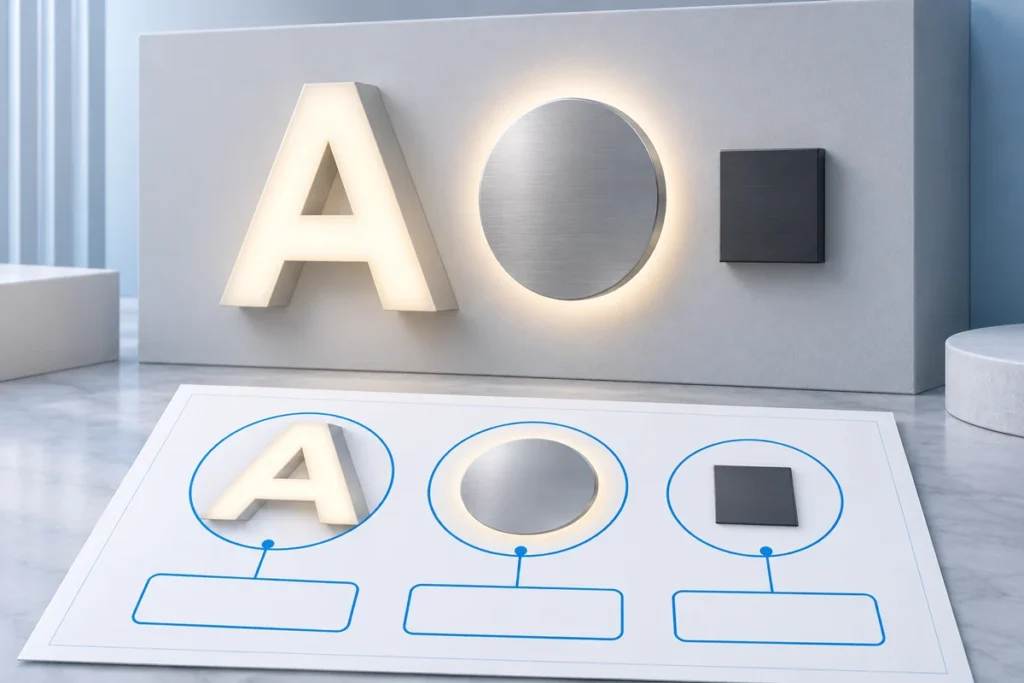
A logo file can show every shape clearly without explaining which shapes should emit light. The main name might need an illuminated face, an emblem might need a halo, and a small descriptor might be intentionally unlit. If those intentions remain in separate messages, an unmarked area can become an assumption during quotation.
A logo illumination intent schedule connects each appearance request to a specific element on one identified artwork revision. It is a suggested buyer brief, not a fabrication specification or a promise that every requested combination is possible. Its purpose is to make the questions visible before the manufacturer develops the construction proposal.
Give each element a reference on one front view
Start with the actual logo composition and proposed overall dimensions. Add simple references to a review copy: one for the emblem, another for the main name, and another for the descriptor or accent. If different parts of the same shape have different requested appearances, identify those parts separately for discussion.
Keep the original artwork unchanged. Annotation lines, reference circles and colored highlights should be recognizable as comments, not additional cut shapes or brand colors. Our vector artwork preparation guide covers the separate task of communicating the physical outlines and small details.
Write the artwork filename and revision beside the schedule. A reference such as “emblem E1” is useful only if everyone can find the same E1 on the same composition. Avoid attaching an older preview to a newer list of intentions.
Record the visible effect without implying a control system
For each reference, state whether you want light through the face, a halo behind the element, both effects, no intentional illumination, or an option still to be discussed. Describe the appearance in words instead of relying on the color used to highlight the drawing.
For example, stainless steel front-lit letters combine an illuminated acrylic face with a visible metal profile. Our front and back lit trimless letters combine a luminous face with a rear halo. Those product descriptions help name the intended effects; they do not establish what can be combined within a particular logo.
This schedule describes a static appearance. It is not an RGB zone map, circuit diagram or statement that elements can be switched independently. If independent operation matters, identify it as a separate requirement for the team to review rather than treating the element references as control channels.
Use a schedule that keeps unanswered points visible
The following entries are illustrative prompts, not a proposed product configuration. Replace them with the references from your artwork. Carry the same proof revision across the record, and add the manufacturer’s response before treating a request as confirmed.
| Element reference | Requested appearance | Boundary to identify | Question still requiring review |
|---|---|---|---|
| E1: emblem | Face illumination requested; halo undecided | Outer outline and any enclosed opening | Which construction and proof can demonstrate the proposed result? |
| T1: main name | Face and rear halo requested | Letter outlines and spaces between characters | Can the supplied artwork support the requested combination, and what changes are proposed? |
| D1: descriptor | Intentionally unlit | The complete small-letter group | How will this group be represented alongside the illuminated elements? |
| A1: accent | Undecided; do not assume illumination | The exact accent shape | What alternatives should be compared before a choice is made? |
Add fields for the linked proof revision, feasibility response and accepted proposal reference. “Undecided” is a useful status: it prevents a missing instruction from looking like an approved effect. An open point should remain open until the buyer has reviewed the answer.
Mark negative space and intentionally unlit areas explicitly
A dark patch in a preview can mean several different things: a metal face, a painted detail, an opening through the artwork or simply the background behind the sign. Identify which meaning applies. Where a letter contains an enclosed opening, show that boundary rather than leaving its interpretation to a glow effect in a rendering.
Also describe what you expect around an intentionally unlit element. Should a halo from a neighboring element appear in that part of the composition? Is the request about the element itself, the surrounding background, or both? Ask the manufacturer to mark any limitations on the proposed visual reference. Do not treat the word “unlit” as a guarantee of a perfectly dark boundary.
Ask for a construction response against the same references
Return to each element after the team has reviewed the artwork. Record whether the request is feasible as proposed, needs a different construction, requires an artwork adjustment or remains unresolved. If one connected shape contains several requested effects, ask the team to explain the proposed arrangement; do not assume the drawing can be divided into separately built or separately operated parts.
Keep suggested changes visible on a new identified proof. The useful response points to the affected element and explains what the buyer must decide. A general message saying “lighting confirmed” leaves too much uncertainty when different parts of the logo have different intentions.
Send a brief that can produce specific answers
Adapt this request: “Please review artwork [file and revision] using the attached element references. For each element, confirm the feasible face and rear-light appearance, identify intentionally unlit areas, and mark any boundary or artwork change needed. Keep undecided items open and identify the proof or drawing that represents your proposal.”
Send HLW SIGN your annotated logo brief with the matching artwork, proposed dimensions, wall photograph, installation setting and delivery country. Ask which review material applies to the quotation. Keep the accepted illumination-intent record with the corresponding proposal so that a later discussion refers to the same visible result.