
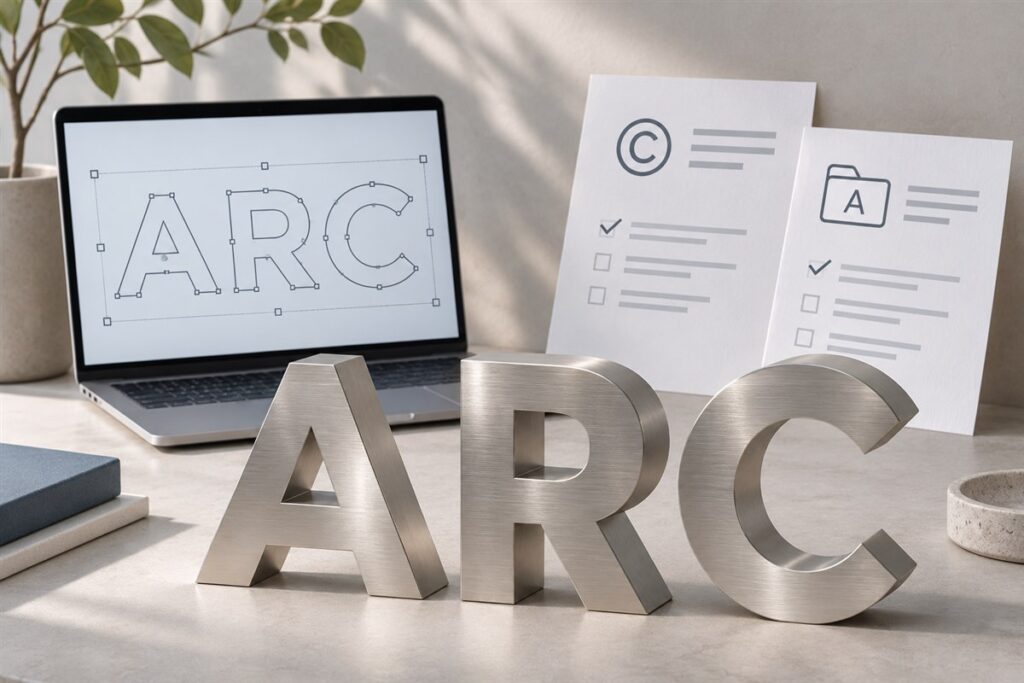
Before sending lettering to a sign maker, resolve two questions: may the selected font be used for this physical sign, and may its font software be passed to another party? Approval of the wordmark’s appearance does not answer both. Keep the font-use decision with the artwork handover.
For non-illuminated metal letters, the production discussion concerns the fixed shapes in the approved wording. The fabricator may need suitable artwork rather than an installable font file. Ask what deliverable is needed before adding font software to the package.
Ask the designer to identify the actual font
Record the family, style and version where available, together with the source from which it was obtained. A familiar family name or an installed file does not explain which terms apply to that copy. Ask the designer to identify the relevant license or service terms and the intended sign use being checked.
Describe the project plainly: the physical lettering, its commercial purpose and any planned additional signs or later wording changes. Keep a record of who checked the applicable conditions and which question remains unresolved. If the source or permission is unclear, request clarification from the font provider before treating the artwork as ready for that use.
Read the conditions for the identified source
The Google Fonts FAQ permits commercial use, logos and use on physical surfaces. It also states that usage and redistribution follow the applicable license conditions. Retain the license information for the selected font rather than assuming that a download described as free has the same terms as every other font.
The Adobe Fonts licensing FAQ applies to fonts added through an Adobe account. It permits creating images or vector artwork, but prohibits packaging font files for transfer to another user. It distinguishes clients receiving graphics or documents with rasterized or properly embedded font data from clients needing direct font access for editing; those editors need their own license. Separately installed fonts have their own agreements.
Use these source-specific answers for the fonts they cover. For another foundry or distributor, ask for that font’s applicable terms. The decision should identify the actual font and proposed use, rather than rely on a general assurance that a designer can open it.
Choose the handover without assuming a font-file transfer
For fixed wording, ask the designer about delivering appropriate outlined artwork that matches the accepted visual proof. This preserves a defined set of letter shapes for review. Converting text to outlines is not a substitute for checking permission for the intended use.
Our vector artwork preparation guide covers the separate technical questions about outlines and paths. Here, confirm whether the package contains fixed artwork, live text requiring font access, or both. Keep any proposed delivery of the font software as a distinct licensing question.
If another person needs to edit live text, ask how that person will obtain the appropriate font access under the applicable terms. Do not assume that sending the editable design also authorizes sending its font files. A clearly identified artwork deliverable avoids leaving the recipient to guess which files they may use.
Keep a font-use and handover record
Copy this blank checklist for the actual wordmark. The entries are questions to resolve, not a prewritten permission statement. On a phone, swipe the table horizontally to see all four columns.
| Decision | Reference to retain | Question to confirm | Outcome and owner |
|---|---|---|---|
| Font identity | [Family, style, version and source] | Which font and applicable terms were used for this artwork? | [Confirmed reference / unresolved source; responsible person] |
| Physical sign use | [Intended use and relevant license or service terms] | Has this proposed use been checked against those terms? | [Confirmation or provider question; reviewer/date] |
| Delivered artwork | [Artwork file/revision and matching visual proof] | Is the delivery fixed artwork, live text or both? | [Agreed deliverable; designer and recipient] |
| Font software | [Applicable sharing terms and recipient’s access arrangement] | Is a font-file transfer permitted, or must the recipient obtain their own access? | [Confirmed arrangement / pending clarification] |
| Future edits | [Editable-master holder and contact] | Who will revise the wording using appropriate font access? | [Named editor; agreed handover responsibility] |
Plan future changes before releasing the fixed artwork
Agree who will keep the live-text master and handle a later name, descriptor or address change. A designer with appropriate font access can retain that editable version while supplying the agreed fixed-shape artwork for the current sign. Confirm this arrangement rather than assuming every recipient receives editable font software.
When wording changes, return to the responsible editor and issue a new artwork revision and visual proof. Keep the font-source and permission record associated with the revised request. This makes future work traceable without turning the sign maker into the decision-maker for another party’s font terms.
Send HLW SIGN your approved artwork and agreed handover format, with the intended non-illuminated lettering, proposed dimensions and delivery country. Identify any font-use question still with the designer or provider. Explore Buyer Resources for related planning records.