
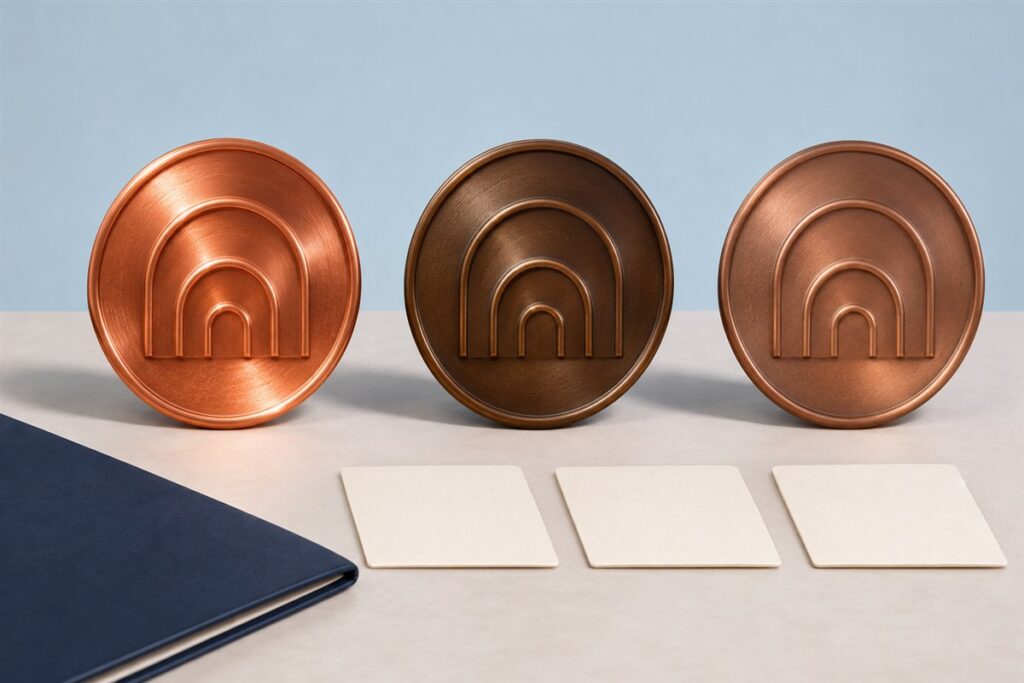
“Copper finish” can describe two different priorities: the sign must be made from copper, or the sign should have a particular copper-colored appearance. A reference photograph may leave that distinction unresolved. It may also show the look you want on delivery without explaining whether you would welcome a changing surface later.
Our embossed metal signs list aluminum alloy or copper as material options, with the actual thickness and finish to be confirmed for the project. Begin the conversation by separating the required metal, the initial appearance and your expectation for that appearance over time.
Say whether copper is the material requirement or the color reference
If the project requires copper as the base metal, state that explicitly and ask the supplier to identify the proposed material or alloy. Do not accept a finish name as the material answer. “Copper-colored” on its own does not establish what the sign is made from.
If the warm metallic color is the priority and the base material is open for discussion, say so. Ask which material-and-finish options the team can actually propose for this sign and location. That gives the supplier room to answer the real brief without suggesting that an alternative is automatically equivalent to copper metal.
Keep “copper,” “bronze,” “antique” and any supplier color name tied to the references you are discussing. Ask what each term means in the proposal: the actual metal, a color description or a particular surface appearance. An appealing name should not settle an unanswered material question.
Describe the look you want at delivery
Identify the starting appearance you want to discuss: bright, muted, darker or deliberately varied, together with the desired sheen. If your reference shows an aged-looking surface, say whether that is the appearance wanted when the sign arrives or a change you would accept developing later.
For example, one fictional buyer requires copper metal and welcomes a changing surface. Another wants a particular warm tone beside existing door hardware, with the material still open. Those buyers should not receive the same instruction merely because both attached a copper-colored picture.
Our stainless steel finish guide covers a different material and its surface specification. Its process descriptions should not be carried over to copper as though the materials or offered treatments were identical.
State your expectation for later change
Aurubis’s description of its Nordic Standard copper provides a useful material example: the untreated bright surface oxidises and its appearance develops with the local environment. That product reference is not a specification for HLW SIGN’s supply. Ask what should be expected from the actual metal, surface treatment and location in your proposal.
Replace “natural ageing is fine” with a more useful description of the change you would accept. Is a darker appearance welcome? Would variation between areas be part of the intended character, or would it conflict with the design? These are buyer preferences to discuss, not predictions of how this particular sign will change.
If keeping the initial appearance is important, make that a project requirement for the supplier to assess. Ask what proposed surface treatment, care and future attention that expectation depends on. If a protective finish is proposed, ask what it changes about the appearance and what maintenance the actual system requires. Do not assume that such a finish is included or that it keeps the sign unchanged indefinitely.
Use a decision table to establish your priorities
The rows below are possible priorities that can overlap. Use the ones that apply to your project and identify any tension between them. On a phone, swipe the table horizontally to see all four columns.
| Your priority | Make this explicit in the brief | Ask the supplier | Keep open until answered |
|---|---|---|---|
| Copper metal is required | The base metal matters, not only the color | Which material or alloy is actually proposed? | The material identity; a color name is insufficient |
| Copper color is the main goal | The base material remains open for discussion | Which available options address the appearance and setting? | The offered material-and-finish combination |
| A changing surface is welcome | Describe what change or variation you would accept | What should be expected for the proposed finish at this location? | The relationship between your preference and the actual proposal |
| Retaining the initial look is important | State that expectation before choosing the construction | What option, limitations and care requirements can the team propose? | Any treatment, maintenance or future attention the answer depends on |
Request a proposal that answers all three decisions
Send the installation setting with your appearance reference. State whether the sign is indoors, sheltered or exposed, and identify any existing surface you are trying to coordinate with. Ask the team to respond separately on the proposed metal, the delivered surface and the expectation for later change.
If the available option does not address one of your priorities, keep that point open. Decide which requirement can change before treating the proposal as accepted. A present-day appearance reference records a starting look; it should not silently become a promise of a permanent future color.
Send HLW SIGN your artwork, location and copper-finish priorities. Say whether copper metal is required and whether an evolving surface is welcome. Ask which material and finish the team can actually offer for that brief. Browse the buyer resources for other design and order decisions.