
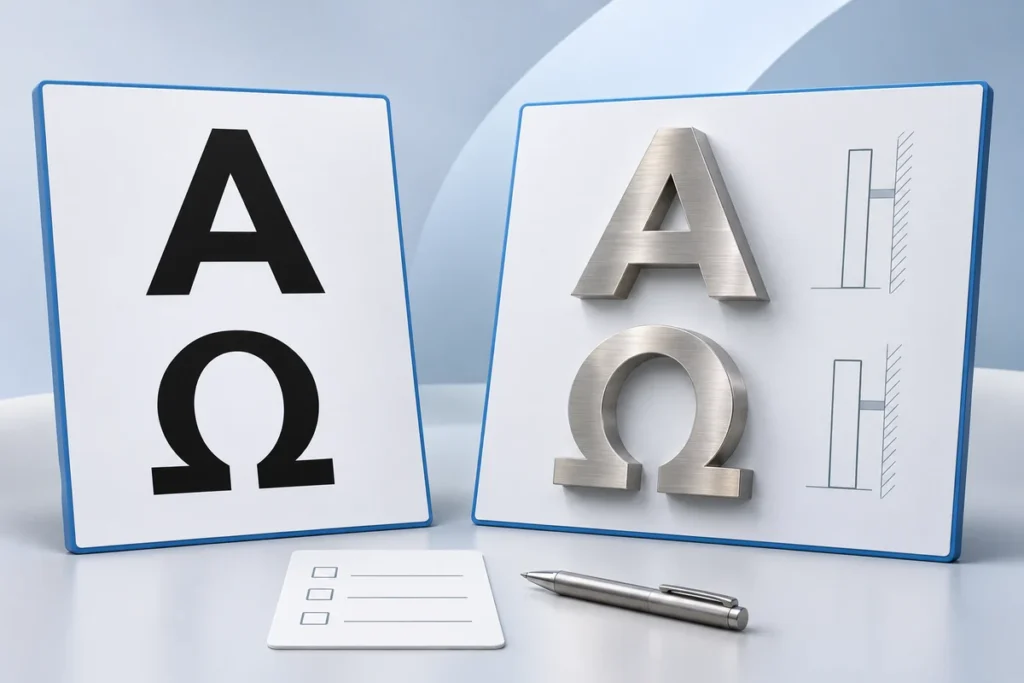
A multilingual sign can match its fabrication drawing and still display the wrong wording. An omitted mark, an outdated translation or a rearranged line may survive every material and dimension check if nobody has explicitly approved the language. Separate the question “Are these the right words?” from “Is this the right sign construction?”
This is especially useful when ordering non-illuminated metal letters for a reception or brand wall. Their identity comes from the shapes, finish and arrangement rather than internal LEDs. The buyer should provide an approved wording reference before those shapes become a production instruction. The process below is a suggested buyer checklist, not a statement that translation or proofreading services are included in an order.
Name a wording approver for each language
Identify who can approve the meaning, spelling and preferred local form of every line. That may be the brand owner, an authorized translator or a suitably qualified language reviewer chosen by the buyer. A person approving dimensions or a metal finish should not silently become responsible for a language they cannot assess.
Give the reviewer the complete composition, not only a detached word. Include the brand name, descriptor, punctuation, numbers and the intended line breaks. Ask whether the sign should use a translated name, an approved transliteration or an unchanged brand mark. Resolve that choice before the artwork is treated as final.
- List every language and name its wording approver.
- Identify any brand names or expressions that must remain unchanged.
- Record the approved wording in an editable master and provide an approved visual reference.
- Keep unresolved wording visibly marked as unapproved.
Check the exported proof, not just the message containing the text
A correct sentence in an email does not prove that the artwork displays it correctly. Open the actual exported proof that will accompany the order. Have the language reviewer check the full composition, including mixed scripts, numbers and punctuation, rather than approving a filename or a small preview.
The W3C explanation of bidirectional text shows why a visual check matters: in browser-rendered text, stored character order and displayed order can differ, while punctuation placement depends on directional context. This is not a rule for every design application. It is a reason to verify the actual exported result instead of assuming that copying a text string preserves the intended reading layout.
Ask the reviewer to mark corrections on that proof. Do not try to repair unfamiliar text by manually reversing its characters or moving a mark until it looks plausible. Return the issue to the language reviewer and designer, then issue a new identified proof.
Keep a wording approval record beside the drawing
Copy this blank record into the project documents. Use a separate line reference for each wording item when the sign contains several languages or messages. Fill the fields with actual project information; an empty cell is an outstanding question, not an approval.
| Record field | Complete for this sign | Check before release |
|---|---|---|
| Sign and line reference | [Sign ID / line ID] | The record points to the correct wording in the complete layout. |
| Language and wording owner | [Language / approver / role] | The named person can approve that wording. |
| Approved copy master | [File / revision / date] | The text is current and unresolved items are identified. |
| Approved visual proof | [File / revision / date] | Character appearance, reading order, punctuation and line breaks have been checked. |
| Linked production artwork | [Artwork file / revision] | It matches the approved visual reference. |
| Wording sign-off | [Approver / date / written confirmation] | The confirmation refers to these exact files. |
| Fabrication sign-off | [Drawing revision / approver / date] | Construction approval is recorded separately. |
Pair the approved words with the production artwork
Retain the editable wording master even when the designer supplies outlined artwork for fabrication. The visual reference connects the approved language to the physical shapes; the production drawing adds the dimensions, finish and other construction details. Our vector artwork preparation guide covers the separate task of preparing outlines and paths.
Use matching revision references so the fabricator does not have to decide which of several attachments controls the order. Ask for a marked proof if a production adjustment changes a stroke, gap or character relationship. A technically workable adjustment still needs review if it changes the approved wording’s appearance.
Make later wording changes visible
If a reviewer changes one word after the drawing has been approved, identify the affected line and replace both the wording record and the visual proof. Ask which production files and drawing details are affected. Do not assume that a short text correction leaves the overall width, spacing or quoted scope unchanged.
For example, in an illustrative review scenario, a buyer replaces a translated descriptor while retaining the brand name. The useful instruction names the old and new revisions, points to the changed line and asks for an updated layout. “Please use the latest text” is less useful when several people hold different attachments. Confirm the effect on any work already authorized directly with the supplier; this checklist does not establish a production-stop or revision-charge policy.
Send a brief that separates the two approvals
When contacting HLW SIGN, send the approved visual wording proof, its matching artwork file, the proposed overall dimensions, wall photograph and delivery country. Identify the language approver and any remaining wording questions. For non-illuminated wall lettering, also state the material appearance and finish you want reviewed.
Request a quotation for your multilingual metal lettering and ask the team to identify the artwork and drawing revisions used for the proposal. Keep language confirmation and fabrication confirmation as two explicit decisions, joined by the same file references.