
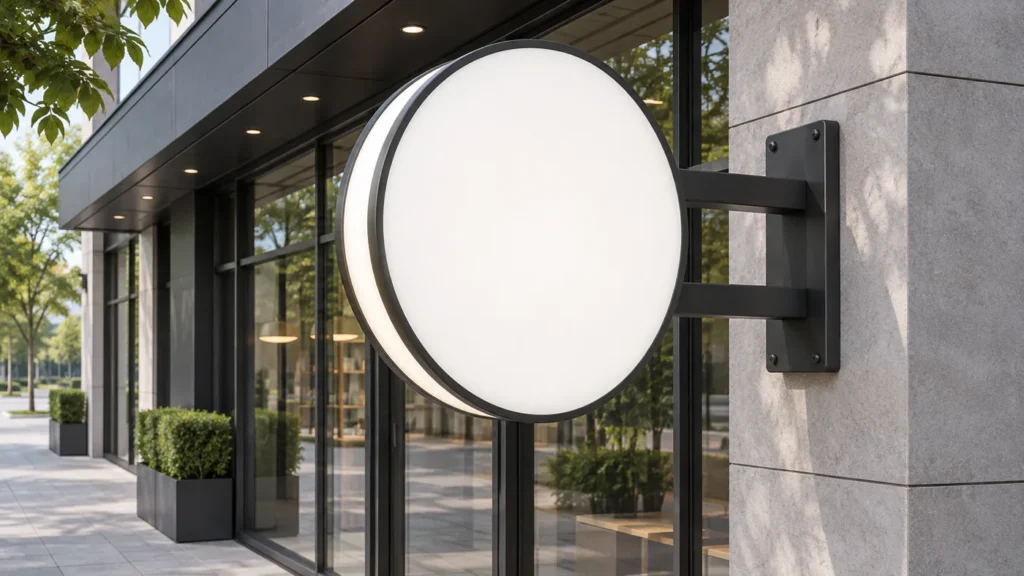
A blade light box projects from a facade so that people approaching along the building can see its faces. This changes the design problem. The sign must work from two directions, fit its surroundings and leave appropriate space for people and maintenance. Start with the viewing geometry and installation constraints before choosing the final cabinet dimensions.
Walk the approach from both directions
A sign can be easy to see when standing directly in front of the shop and almost disappear while walking along the pavement. A projecting face addresses that approach, but nearby trees, awnings, neighboring signs and street furniture can still obstruct it. Photograph each approach at realistic eye level. Mark the point where a visitor first needs to identify the business and the point where they turn toward the entrance.
Consider both faces independently. The same logo may need different layout attention when arrows, opening information or directional text are included. Keep the most important information prominent and avoid filling the cabinet simply because more space is available. Our LED light box signs can be discussed as part of a project-specific storefront layout rather than as isolated decorative objects.
Draw the complete projection envelope
Request a side elevation showing the wall, bracket, cabinet depth and overall projection. The sign face size alone does not communicate how far the assembly extends into the space. Include the actual mounting height, nearby doors and windows, and any public circulation below it. A lower or deeper bracket may change both the structural arrangement and the clearance review.
| Drawing item | Why it matters |
|---|---|
| Face width and height | Defines the visible message area |
| Cabinet depth | Affects side appearance and internal arrangement |
| Bracket projection | Establishes the complete wall-to-edge envelope |
| Mounting height | Supports circulation and viewing review |
| Service opening | Shows how faces or components can be accessed |
| Cable route | Coordinates the sign with the building power connection |
Review circulation requirements locally
A projecting sign is also an object in an occupied environment. Do not select a mounting height solely from a promotional photograph. The U.S. Access Board guide to protruding objects explains why projections and headroom matter in circulation paths in the United States. Requirements depend on the jurisdiction and site; the guide is not a universal permit approval for every location.
Ask the building owner and local qualified team to confirm applicable planning, accessibility and installation requirements. Record who is responsible for that review. If an awning, canopy or other feature is part of the proposed arrangement, include it on the drawings. Avoid treating the sign as an independent item when the final location depends on surrounding building elements.
Keep mounting and future servicing in the same conversation
The bracket and its fixings must be designed for the actual wall and loading conditions. Exposure, cabinet geometry and mounting location are relevant inputs. A large decorative bracket does not prove adequate capacity, and a facade photograph cannot establish the properties behind the visible surface. Have the appropriate designer or installer confirm the complete attachment arrangement.
Then ask how the sign will be maintained. Can a face be removed without disturbing another tenant’s awning? Will a technician need a lift, and is there room to use one? Which components can be reached from the intended service side? These questions help prevent a design that is attractive at handover but unnecessarily difficult to keep in service.
Coordinate it with the main storefront identity
A blade light box and flush channel letter signs serve different viewing positions. They can support the same identity without carrying identical amounts of information. For example, a compact projecting logo can identify the entrance along a row of shops while the larger wall lettering names the business from across the street. Keep colors and graphic proportions consistent across the two constructions.
Use the custom signage design process to coordinate the cabinet, bracket and graphic rather than approving them as separate purchases. Request a daytime rendering and an illuminated view, but treat these as visual planning tools. Final brightness, finish and installation details still need confirmation on the actual order.
Frequently asked questions
Does double-sided mean both faces must use identical artwork?
No. Artwork can be adapted where direction or site context requires it. Confirm both faces explicitly so the intended orientation is clear during production.
Can an existing bracket be reused?
Only after its condition, dimensions, attachment and suitability for the new assembly have been checked by the responsible qualified team. Appearance alone is not enough.
What should I send for an initial review?
Send the logo, rough face dimensions, side-view measurements, facade photographs and the proposed location. Identify who will manage local approvals and installation.
Contact HLW Sign with your storefront views and projection constraints to discuss a custom blade light box layout.